A Useful S-Meter Design for Direct-Conversion Radios
Rolf Heine, DL6ZB (ex DL6MBI)
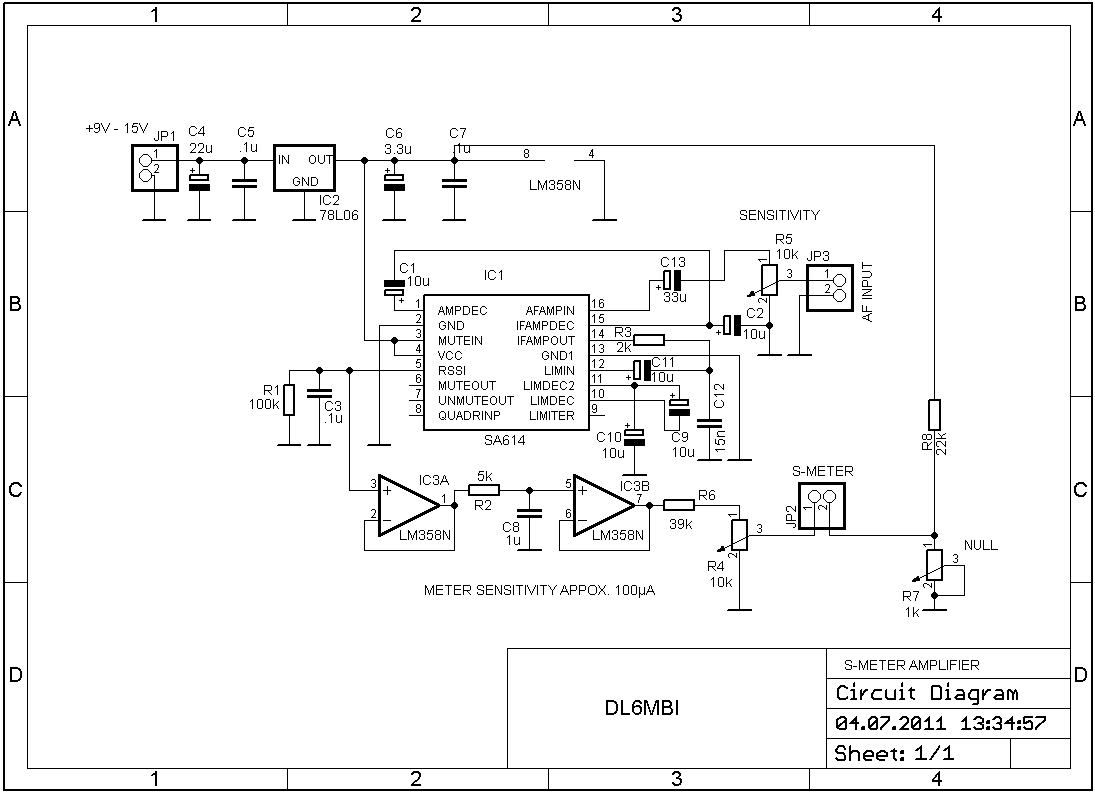
This S-meter circuit indicates the field strength, derived from the AF signal of a direct-conversion receiver. The SA614 logarithmic amplifier offers 90 dB of dynamic range, which is enough for simple receivers. If properly constructed, this S-meter amplifier should be more accurate than the S-meters in most commercial amateur radio equipment.
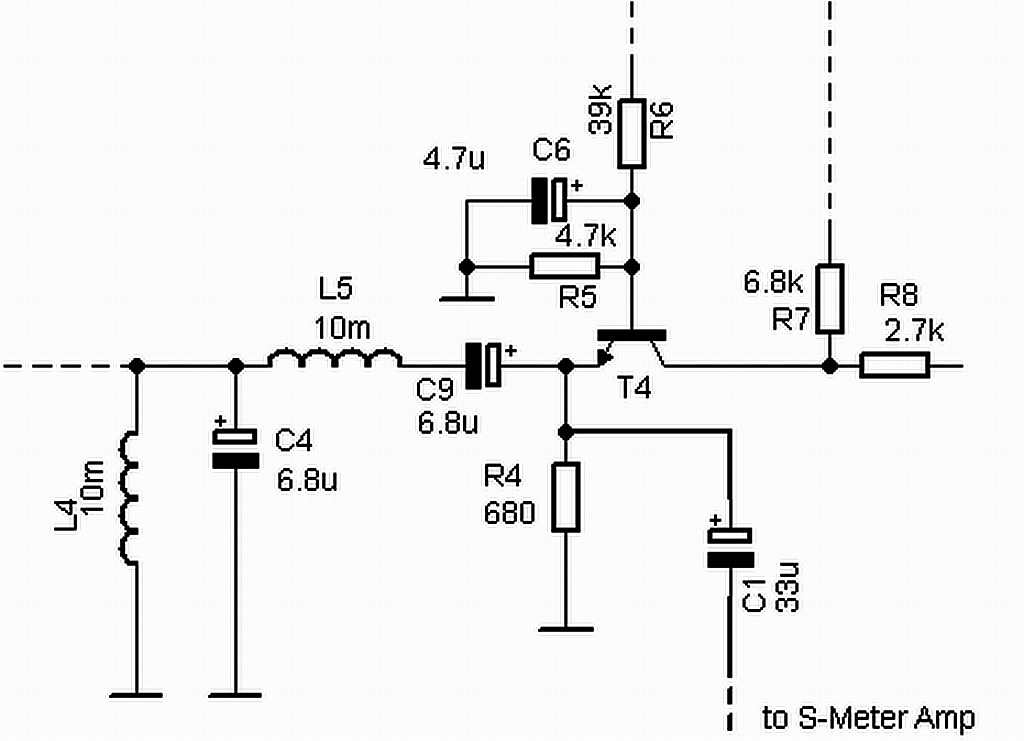
The best results are obtained with low-impedance sources. In the Type 002 DC receiver, a suitable point for decoupling the signal is the end of the 0.5–1.5 kHz Chebyshev bandpass filter, at the emitter of transistor T4 (a decoupling capacitor of several microfarads is necessary).
The SA614 logarithmic amplifier is available from several sources, one of which is RS Components. Google it!
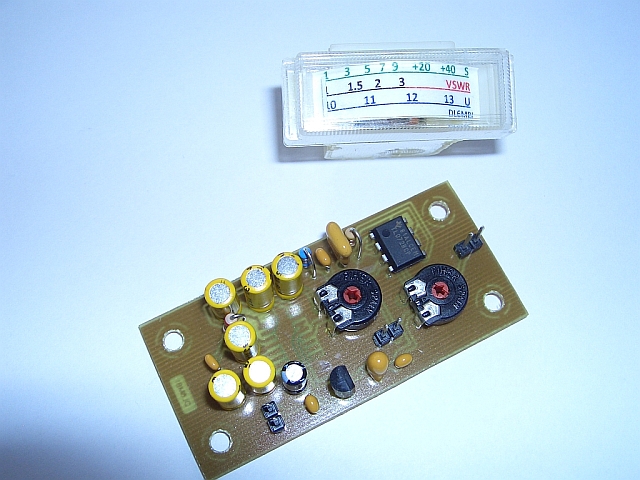
The SA614 is an SMD part. It is mounted on the bottom side of the circuit board. The picture shows a TL072 dual op-amp; in the meantime, however, I have replaced it with an LM358 because it works from a single supply voltage. I use a 100 µA meter as the indicator. You will have to adapt the output resistor network to obtain a suitable output current. With no input signal, an output current of a few microamperes remains, so the meter needle is not exactly at zero. If you want maximum readout accuracy, you need to compensate for this residual current by properly selecting R4, R6, R7, and R8. The resistor network suggested in the circuit diagram is suitable for a 100 µA meter.
The meter I used is from the German distributor Bürklin (www.buerklin.com), part no. 16K210.
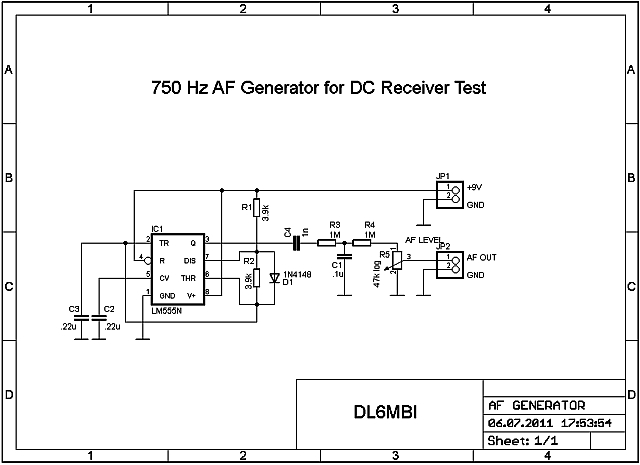
I printed an S-meter scale on a simple printer after measuring the signal strengths. If you don't have a signal generator for calibration, I recommend building a simple test generator from an NE555 and a variable resistor. The frequency should be set to approx. 750 Hz.
Fortunately, the plastic cover of the meter can (CAREFULLY!) be removed. After removing the plastic cover, you can remove the original glued-on scale. Glue the new scale into the meter, and you have a nice personalized S-meter and VSWR meter. I also use the meter to measure the supply voltage. Even more measurements are possible, depending on your requirements.
When the transceiver is switched on, it usually takes a few seconds until the needle drops to zero. I currently use a 78L08 voltage regulator instead of a 6 V type, because I couldn't find a 6 V regulator in my junk box… :-)
PCB layout for the EAGLE layout editor: download the ZIP file.